
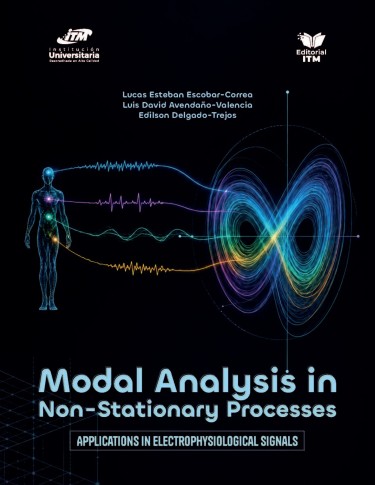
Modal Analysis in Non-Stationary Processes
Applications in Electrophysiological Signals
Lucas Esteban Escobar-Correa · Luis David Avendaño-Valencia · Edilson Delgado-Trejos
Editorial ITM
Sinopsis
Electrophysiological signals, such as electroencephalography (EEG) signals, are complex by nature, exhibiting non-linear and non-stationary behavior, leading to limitations in their analysis and the development of effective clinical applications. Modal decomposition has proven valuable for studying the dynamic of physiological systems, particularly in disease diagnosis and functional state detection, by decomposing signals into modes that capture essential information. However, existing methods face difficulties with time-varying noise and singularities, such as crossing frequencies and vanishing amplitude components, leading to imprecise applications.
The proposed approach in this research book aims to evaluate the EKFs method and two optimized approaches of this technique, using the Metropolis-Hastings Markov Chain Monte Carlo (EKFs−MH) and Expectation-Maximization (EKFs−EM) algorithms, with both a numerically generated non-stationary signal and EEG signals for seizure prediction. The optimized approaches demonstrated superior performance, successfully managing singularities and minimizing errors in state-space representation.
Contenido
- List of Figures — p. vi
- List of Tables — p. viii
- Abstract — p. x
- 1 Introduction — p. 1
- 1.1 Justification — p. 2
- 1.2 Problem description — p. 3
- 1.3 Hypothesis — p. 4
- 1.4 Objectives — p. 5
- 1.4.1 General Objective — p. 5
- 1.4.2 Specific objectives — p. 5
- 1.5 Manuscript structure — p. 5
- 2 State of the art — p. 6
- 2.1 Empirical Mode Decomposition (EMD) — p. 7
- 2.2 Proper Orthogonal Decomposition (POD) — p. 9
- 2.3 Variational Mode Decomposition (VMD) — p. 10
- 2.4 Time-frequency transform — p. 10
- 2.5 State-space representation — p. 11
- 2.6 General considerations — p. 12
- 3 Experimental framework — p. 13
- 3.1 Datasets — p. 13
- 3.1.1 Generated non-stationary signal — p. 13
- 3.1.2 Electroencephalography database – Siena Scalp EEG — p. 15
- 3.2 Time-dependent state space modal representation — p. 16
- 3.3 State-Space representation estimation — p. 19
- 3.3.1 Extended Kalman Filter — p. 19
- 3.3.2 Kalman Smoother — p. 22
- 3.3.3 Initial conditions estimation — p. 22
- 3.4 State-space representation optimization — p. 23
- 3.4.1 Expectation-Maximization (EM) — p. 23
- 3.4.2 Metropolis-Hastings Markov Chain Monte Carlo — p. 26
- 3.5 Classification — p. 29
- 3.5.1 Features generation — p. 29
- 3.5.2 Feature selection — p. 30
- 3.5.3 Random Forest (RF) — p. 31
- 3.6 Proposed methodology — p. 32
- 3.6.1 Methodology for the first objective — p. 33
- 3.6.2 Methodology for the second objective — p. 35
- 3.6.3 Methodology for the third objective — p. 39
- 4 Results and discussion — p. 44
- 4.1 First objective results — p. 44
- 4.2 Second objective results — p. 47
- 4.2.1 Non-stationary generated signal — p. 47
- 4.2.2 EEG signals. — p. 52
- 4.3 Third objective results — p. 54
- 5 Conclusions — p. 63
- 6 Future work and recommendations — p. 65
- 7 Intellectual property — p. 66
- 8 Impacts — p. 67
- 9 Conflicts of interest — p. 68
- Bibliography — p. 69
Materias
Palabras clave
BISAC
- SCI055000. CIENCIA > Física > General
Thema
- PBKS. Análisis numérico
Dewey
- 621.3. Tecnología (ciencias aplicadas) > Ingeniería y operaciones afines > Física Aplicada > Eléctrico, electrónico, magnético, comunicaciones, ingeniería informática; iluminación