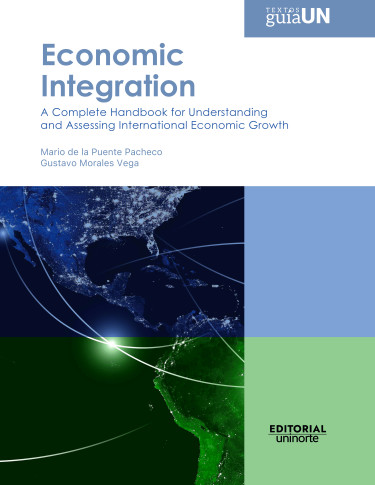
Economic integration
A complete handbook for understanding and assessing international economic growth
Mario De la Puente Pacheco · Gustavo Morales Vega
Editorial Universidad del Norte
Sinopsis
As the world became increasingly interconnected and the global economic order continued to evolve, understanding the intricacies of economic integration are more crucial. This guidebook serves as an invaluable resource for students, policymakers, and anyone seeking to grasp the complexities of the global economy. By providing a comprehensive framework for analyzing economic integration and its manifestations across the world, it gives readers the knowledge and tools necessary to navigate the ever-changing landscape of international economic relations.
Sobre los autores

Mario De la Puente Pacheco
Doctor en Análisis Económico Internacional de la Universidad Rey Juan Carlos de Madrid (España). Profesor-investigador de la Universidad del Norte (Colombia). Miembro del grupo de investigación “Agenda Internacional" avalado por Colciencias. Premio Innovación Pedagógica Uninorte 2017. Sus líneas de investigación son: Turismo médico, Movilidad sanitaria internacional, Economía e ilegalidad.

Gustavo Morales Vega
PhD in Political Science from Carleton University, Master’s in International Relations from the Università di Bologna, and a Bachelor’s degree in Political Science from Universidad de Los Andes. His areas of interest include global politics, democracy, Latin America, and theoretical debates surrounding constructivism, critical theory, and liberalism.
Contenido
INTRODUCTION - 1
CHAPTER 1
ECONOMIC INTEGRATION: DEFINITION AND IMPORTANCE FOR COUNTRIE´S DEVELOPMEMT
Objectives - 4
Introduction - 4
Prior knowledge activation technique - 6
Conceptual map - 9
Definition of economic integration - 10
Comprehensive definition of economic integration - 10
Countries forming closer economic relationships - 16
Introduction to various forms of economic integration - 21
Emphasis on te free flow of goods, services, capital and labor across borders - 24
Increased market access, economies of scale, enhanced competitiveness, and political coperation - 29
Conclusion - 34
CHAPTER 2
TYPES OF ECONOMIC INTEGRATION
Objectives - 38
Prior knowledge activation technique - 38
Conceptual map - 38
Preferential trade agreements (PTAs): navigating the inceptives ties - 40
Preferential trade agreements (PTAs): catalysts for economic synergy - 42
Challenges and consideration -62
Conclusion - 64
CHAPTER 3
ADVANTAGES AND DISADVANTAGES OF ECONOMIC INTEGRATION.
Objectives - 67
Disadvantages of economic integration - 79
Implications from a quantitative standpoint with examples - 84
Social mobility implications with examples - 86
Conclusion - 94
CHAPTER 4
EXAMPLE OF ECONOMIC INTEGRATION IN THE WORLD
Objectives - 98
Pre - organizer - 98
European Union - 99
Legal foundations of the European Union - 101
Key legal principles - 103
Economic integration of the European Union - 104
Implications of EU - 106
Legal and economic foundations of MERCOSUR a simbyotic framework for regional integration - 112
Conclusion - 115
CHAPTER 5
THE PACIFIC ALLIANCE WITHIN THE STRATEGIC PLAY OF WORLD AND REGIONAL INTEGRATION
Introduction - 121
World structure, multilateralism and regional integration - 122
Hemispheric structure, regional integration and PA - 129
Conclusion - 137
References - 138
Glosary - 142
The authors - 143
Materias
BISAC
- POL011020. CIENCIAS POLÍTICAS > Relaciones Internacionales > Comercio y aranceles
Thema
- KCL. Economía internacional
Dewey
- 327. Sociología y Antropología > Ciencias Políticas > Relaciones Internacionales

Declaración de Prestigio Académico
Lo que la editorial declara sobre la evaluación de esta obra.