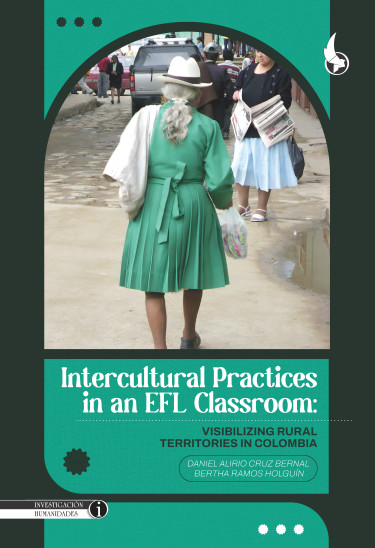
Intercultural Practices in an EFL Classroom:
Visibilizing Rural Territories in Colombia
Daniel Alirio Cruz Bernal · Bertha Ramos Holguín
Editorial UPTC
Sinopsis
This book is intended for English language teachers who are concerned about comprehending how diversity might take place in EFL classrooms. It is easy to think of all language learners as similar- they are all learning English. The reality is that diverse groups of English as a foreign language learners bring to the classroom substantial differences. As such, this book is an attempt to honor the group of students we worked with and their territories. We looked at interculturality as an opportunity to learn from the rich cultural background of our students. The four participants in this qualitative case study belonged to a Language Institute at a public university in Tunja, Boyacá, Colombia. They unveiled the intercultural practices they nurture while participating in intercultural encounters as part of their EFL classes. By sharing dialogical spaces, our participants let us listen to their voices which honor rural territories and local practices. This research study helped us to denormalized knowledges that have been usually vanished in academia.
Sobre los autores

Daniel Alirio Cruz Bernal
Holds a B.A. in Modern Languages and an M.A. in Language Teaching. He is member of the research group “TONGUE”. He currently teaches at Alliance College in Sydney, Australia.

Bertha Ramos Holguín
Doctora en Ciencias de la Educación y profesora titular de la Escuela de Lenguas Modernas con Énfasis en Inglés de la Facultad de Ciencias de la Educación de la Universidad Pedagógica y Tecnológica de Colombia (UPTC). Es la líder del grupo de investigación TONGUE y sus líneas de investigación actuales son interculturalidad, formación docente y didáctica de las lenguas extranjeras.
Contenido
15 COMPREHENDING ECOSYSTEMS
21 PLANTING THE SEEDS
27 FERTILIZING THE SOIL
27 Diversity in an EFL classroom
29 Interculturality as a possibility of social construction
32 Intercultural Practices in the Territory
35 Rurality
39 LEARNING ABOUT CROPS
39 Research Approach
40 Research Paradigm
40 Type of Study
42 Data Collection Instruments
42 Students’ Artifacts
46 Field Notes
47 Focus Groups
48 Audio-recording (transcripts)
48 Context
50 Participants
51 Sample
52 Ethical Issues
55 HARVESTING LEGACIES
57 Case study 1: Fray
58 Themes
65 Case study 2: Deisy
66 Themes
75 Case study 3: Santiago
75 Themes
85 Case study 4: Robin
85 Themes
91 Stretching the Territory through a Critical Intercultural Posture
99 The Integration of Local and Indigenous Saberes as a Guideline to Decolonize the Self, the Land, and the Curriculum
115 Individuals’ Intercultural Practices Understood as a Social Transformation Claim
123 PRESERVING THE GARDEN
133 References
Materias
Palabras clave
BISAC
- PHI000000. FILOSOFÍA > General
Thema
- JNA. Filosofía y teoría de la educación
Dewey
- 370. Sociología y Antropología > Educación > Educación