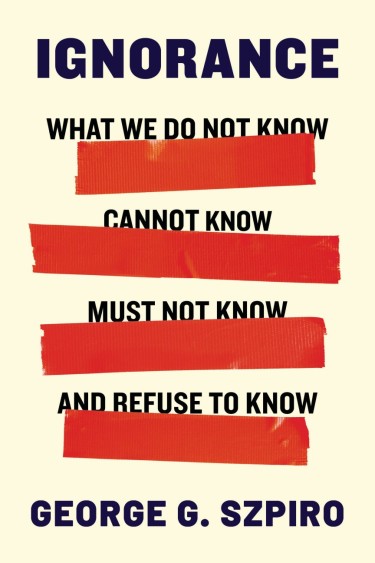
Ignorance
What We Do Not Know, Cannot Know, Must Not Know, and Refuse to Know
George G. Szpiro
Ediciones Uniandes
Sinopsis
Does the lack of evidence mean that aliens don’t exist? Why does an unproven mathematical hypothesis have profound consequences? Are humans capable of grasping the nature of divinity? Is it ethical to give a patient a placebo? Why do people persist in demonstrably false beliefs like flat earth theory? Should someone want to know when they will die?
George G. Szpiro examines these questions and many others, offering an engaging and witty tour of what we can learn from ignorance. In a series of fast-paced chapters, he unravels problems ranging across science, mathematics, law, economics, politics, religion, psychology, and philosophy—some esoteric, others drawn from everyday life. Ignorance comes in many forms, Szpiro shows. Some questions are only temporarily unsolved; others are inherently unanswerable. Sometimes authorities keep answers from us, for good or ill. Often our assumptions and biases keep us from overcoming our ignorance, and occasionally we choose to remain ignorant—for surprisingly rational reasons.
Ultimately, Szpiro argues, ignorance is not purely negative. It can motivate the pursuit of learning and wisdom—as long as we acknowledge it. Presenting sophisticated topics in an accessible way, this book shows how ignorance sheds light on the nature of knowledge.
Sobre el autor

George G. Szpiro
is an author and journalist who was a longtime correspondent for the Swiss daily Neue Zürcher Zeitung. His previous Columbia University Press books are Risk, Choice, and Uncertainty: Three Centuries of Economic Decision-Making (2020) and Perplexing Paradoxes: Unraveling Enigmas in the World Around Us (2024). Szpiro was on the faculty at the Wharton School, University of Pennsylvania, and the Hebrew University in Jerusalem.
Contenido
- Acknowledgments — p. xiii
- Introduction — p. 1
- IDO NOT KNOW
- 1 Do Aliens Visit Us? Flying Saucers and Other UFOs — p. 7
- 2 Knowledge Under Seal: Les Plis Cachets — p. 13
- 3 A Mathematical Riddle: The Riemann Hypothesis — p. 19
- 4 Restricted Access: Top Secret vs. Freedom of Information — p. 24
- 5 Ignoramus et Ignorabimus: A Controversy in Germany — p. 31
- 6 Will the Universe Expand Forever? Big Crunch, Big Bounce, Big Rip, or Big Chill — p. 36
- 7 Ignorantia Legis Non Excusat: Presumed to Know — p. 41
- 8 What Is Nothing? Horror vacui — p. 46
- 9 Is Justified True Belief Knowledge? Gettiers Problem — p. 51
- 10 Hard but Easy: P vs. NP — p. 56
- 11 Ignoring Ones Own Assessment: Ellsbergs Paradox — p. 60
- 12 Its There but Cant Be Seen: Dark Matter — p. 66
- 13 Unskilled and Unaware of It: The Dunning-Kruger Effect — p. 70
- 14 The Hard Problem and the Easy Problem: Understanding Consciousness — p. 74
- 15 Uncharted Depths: Aqua Incognita — p. 81
- IICANNOT KNOW
- 16 On Learned Ignorance: Cardinal Nicolas de Cusa — p. 87
- 17 Where and How Fast? The Uncertainty Principle — p. 91
- 18 Half Zeros, Half Ones: Random Numbers — p. 96
- 19 Satisfice, Dont Optimize: Bounded Rationality — p. 102
- 20 Dont Even Ask: Menos Paradox — p. 107
- 21 Engaging in Risky Behavior: Moral Hazard — p. 112
- 22 Nonlinearities Have Consequences: Chaos Theory — p. 118
- 23 The Sixth Sense in a Post-Truth World: Alternative Facts and Fake News — p. 122
- 24 How Long Is the Coast of Britain? Fractal Dimensions — p. 127
- 25 Is the Solar System Stable? KAM Theory — p. 132
- 26 Entering Infinite Loops: The Turing Halting Problem — p. 136
- 27 True but Not Provable: Gdels Incompleteness Theorems — p. 141
- 28 Storing Music, Photos, Video, and Text: Algorithmic Complexity — p. 146
- 29 Too Far Away: The Light Cone — p. 150
- 30 Is Your Red My Blue? Qualia — p. 155
Materias
Palabras clave
BISAC
- PHI000000. FILOSOFÍA > General
Thema
- Q. Filosofía y religión
Dewey
- 121. Filosofía y psicología > Epistemología, causalidad, humanidad > Epistemología